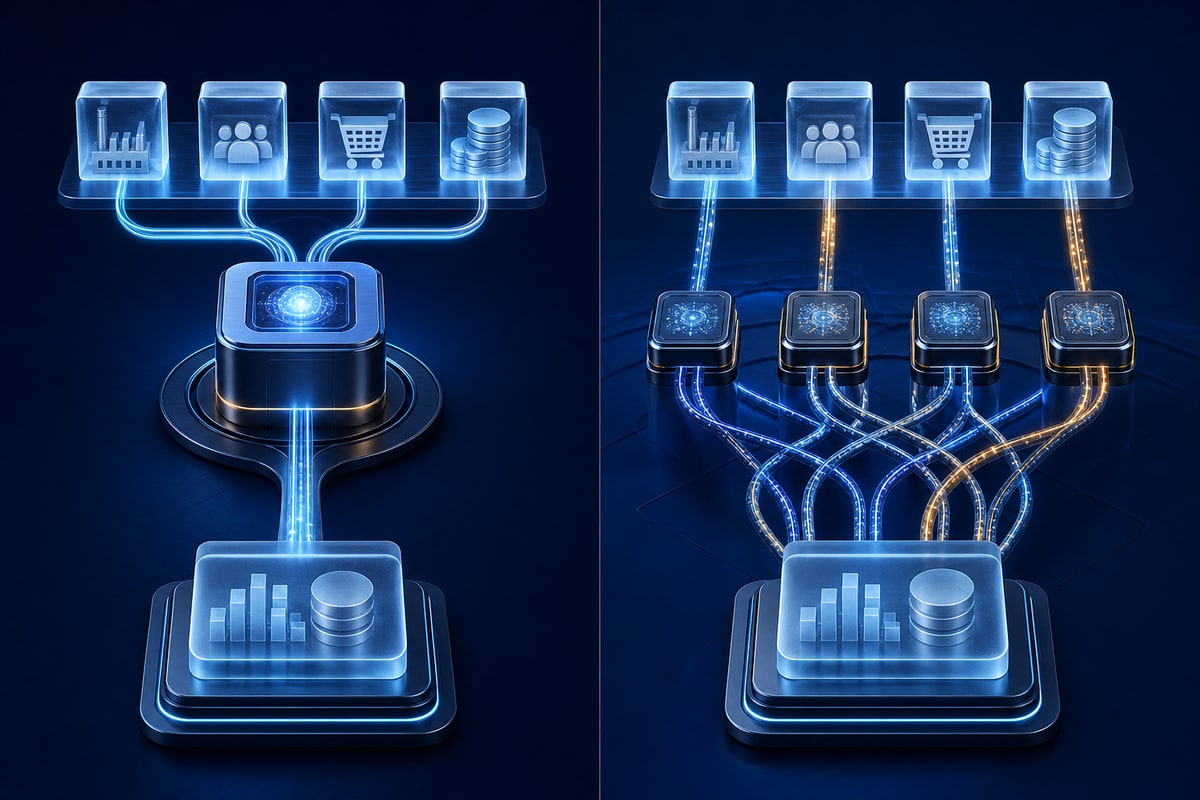
An integration platform as a service can connect common business applications quickly. Custom integration provides deeper control over behaviour, data, and operations. The right choice is not simply “buy or build.” It depends on the workflow's differentiation, failure cost, volume, security boundary, and expected change.
The Short Answer
Choose iPaaS when supported connectors cover the systems, transformations are understandable, time to value matters, and the workflow can operate within the platform's security and reliability model.
Choose custom integration when the process is differentiating, interfaces are unusual, latency or volume is demanding, control requirements are strict, or failures need specialised recovery.
Choose a hybrid when the platform should handle commodity connections while custom services own critical business logic and orchestration.
What an iPaaS Provides
An iPaaS normally offers managed connectors, workflow design, mapping, scheduling, credential handling, monitoring, retries, and deployment. It reduces the amount of plumbing a team must build and can make integrations visible to a broader operations group.
The tradeoff is platform opinion. Connectors expose what the vendor supports, execution and pricing follow its model, and advanced behaviour may require workarounds. “Low code” does not eliminate the need to understand data ownership, idempotency, security, and failure recovery.
What Custom Integration Provides
A custom integration is application code designed around the systems and workflow. It can implement specialised contracts, queues, reconciliation, observability, data residency, throughput, and approval logic.
The business owns that flexibility and also owns maintenance. APIs change, credentials rotate, queues fill, schemas evolve, and people need alerts and runbooks. The initial build estimate is not the total cost.
Compare Eight Decision Factors
1. Connector fit
Test the exact operations, fields, rate limits, webhook behaviour, pagination, and authentication you need. A connector bearing the product's logo may cover only common objects.
2. Business differentiation
Commodity employee synchronisation is a strong platform candidate. Pricing, fulfilment, risk, or inventory logic that differentiates the business deserves closer control.
3. Latency and volume
Check execution limits, concurrency, payload size, batch handling, and queue behaviour at peak—not only average—volume.
4. Reliability
Ask how the platform handles timeouts, duplicates, ordering, partial success, replay, dead letters, and reconciliation. Custom code must answer the same questions explicitly.
5. Security and compliance
Review credential storage, encryption, tenant isolation, access control, audit logs, data location, subprocessors, incident duties, and deletion. Determine whether sensitive payloads pass through or remain stored by the platform.
6. Change and release
Assess version control, code review, testing, environments, rollback, configuration drift, and audit history. Visual workflows still need disciplined lifecycle management.
7. Operating model
Identify who monitors failures, updates connectors, responds after hours, manages certificates, and resolves disputed records. Managed infrastructure is not managed business outcomes.
8. Total cost
Include subscription tiers, execution volume, premium connectors, environments, support, implementation, testing, custom extensions, migration, internal operation, and exit.
A Hybrid Pattern
A retailer might use iPaaS for standard CRM contacts, marketing audiences, and routine file exchange. Payment confirmation enters a custom event service because it requires strong idempotency and audit. A custom order orchestration service applies business rules, while iPaaS distributes non-critical status updates.
The boundary keeps commodity work simple without placing critical state transitions inside a hard-to-test visual flow.
Run a Proof of Fit
Before committing, test one representative happy path and the failures:
- Expired credentials.
- Provider rate limiting.
- Duplicate and out-of-order events.
- Invalid and oversized payloads.
- Destination outage.
- Partial batch failure.
- Schema change.
- Replay and reconciliation.
Measure implementation effort, processing time, operating visibility, unit cost, and recovery—not only whether data moved once.
Avoid Lock-In Through Design
Keep canonical data contracts, business rules, external identifiers, and reconciliation logic documented outside proprietary connector configuration. Export versioned definitions where supported. Define how credentials, logs, pending messages, and state would move if the platform changed.
Lock-in is acceptable when the value exceeds the switching risk and the exit is understood.
Make the Choice per Integration Domain
Do not impose one answer across the company. Classify integrations by criticality, differentiation, data sensitivity, and complexity. Establish an approved platform path and a custom path with clear architecture criteria.
DualByte's system integration service can help evaluate connectors against real failure cases and design a hybrid architecture with clear ownership.
Sources
Need help with implementation?
Get a free consultation with the DualByte team for your business technology needs.